Project URL: dorobistro.pages.dev
Portfolio Exhibit: bongaceron.pages.dev
Role: Front-End Developer / Jamstack Specialist. I served as the UI/UX Designer and Frontend Developer for the D'Oro Bistro Restaurant website prototype. Responsibilities included website planning, user experience design, visual design, responsive frontend implementation, content structuring, branding, and conversion-focused landing page development.
1. Executive Summary
This case study details the design and development of a demonstration website prototype created to showcase how a modern restaurant website could be designed and structured. Built using a modern Jamstack architecture and deployed on Cloudflare Pages, the site presents a professional online presence for a contemporary dining establishment through immersive food photography, elegant branding, intuitive navigation, and a reservation-focused user experience. The website clearly indicates that it is a development prototype and is not an official website commissioned or endorsed by any restaurant or business.
2. The Problem & Local Context
Restaurants in Cagayan de Oro increasingly rely on social media as their primary digital channel, which limits structured discovery of menus, locations, and reservation options. For a dining establishment, a slow or disorganized website creates immediate friction for mobile-first visitors browsing on local data connections.
The prototype was built around three core requirements:
- Instantaneous Performance: Must load instantly on local mobile networks so diners can browse the menu and location without delay.
- Structured Reservation Intake: Replacing scattered social media messages with clear, strategically placed reservation calls to action.
- Appetizing Visual Presentation: Using immersive food photography and elegant branding to establish an emotional connection with visitors.
3. Technical Strategy & Architecture
To ensure maximum speed, security, and zero maintenance overhead, the prototype was developed using a decoupled, Jamstack architecture:
- Static Generation: The entire interface is pre-rendered into semantic HTML, optimized CSS, and minimal vanilla JavaScript across a responsive multi-page experience, keeping the asset footprint small.
- Global CDN Deployment: Hosted on Cloudflare Pages. By serving the site directly from the network edge, the Time-to-First-Byte (TTFB) is near-instantaneous across diner browsers.
- Managed Edge Infrastructure & Hosting: By leveraging an advanced serverless static architecture on enterprise-grade edge networks, the platform scales automatically to handle traffic spikes. This setup eliminates database maintenance, server patching, and dynamic backend hosting fees, delivering continuous uptime and high reliability.
4. Key Design & Implementation Features
A. Hero Section & Brand Story
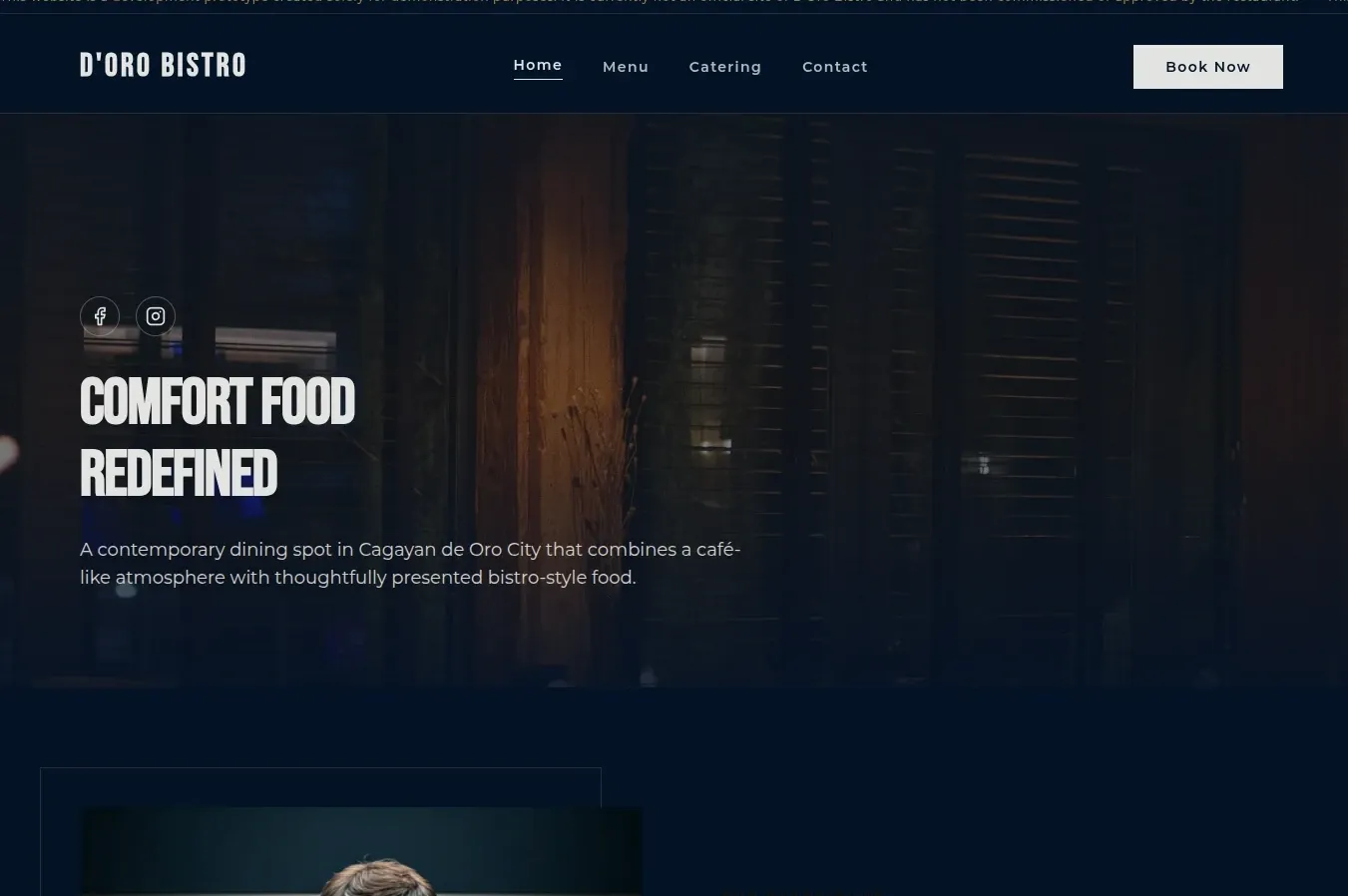
The homepage opens with an eye-catching hero section featuring high-quality food imagery, welcoming messaging, and a prominent call-to-action that immediately introduces the restaurant's atmosphere and dining experience. A dedicated brand story section introduces the restaurant's philosophy and commitment to quality ingredients and memorable dining experiences, helping establish an emotional connection with visitors beyond simply displaying menu items.
B. Featured Dishes & Menu Preview
The prototype highlights carefully selected signature dishes using large imagery and concise descriptions, demonstrating how restaurants can use visual storytelling to entice potential customers. Instead of overwhelming visitors with an extensive menu, the homepage presents a curated selection of popular offerings, encouraging exploration while maintaining a clean and organized layout.
C. Reservation-Focused Multi-Page UX
Strategically placed reservation buttons throughout the page encourage visitors to take the next step without interrupting the browsing experience. The website is built as a responsive multi-page experience—Home, About, Menu, Contact, and additional supporting pages—that improves organization, navigation, search engine optimization, and scalability. The site concludes with essential restaurant information: location, contact details, operating hours, reservation details, and an inquiry section designed to help customers plan their visit quickly and conveniently.
5. Results & Technical Impact
- Multi-Page Architecture: Separating content across multiple pages improves organization, navigation, search engine optimization, and scalability as the restaurant grows.
- Conversion-Oriented UX: Prominent reservation and contact calls to action, a food-focused visual hierarchy, and contact information displayed throughout the site drive customer engagement.
- Hardened Security: With no exposed database or dynamic CMS, the site is inherently secure against common web vulnerabilities.
- Frictionless UX: Diners can quickly explore the restaurant, browse the menu, learn about the brand, and make reservations with minimal friction.
6. Conclusion
This project illustrates how a restaurant website can combine compelling food photography, elegant branding, intuitive navigation, and strategically placed calls to action within a modern experience. While created as a demonstration prototype, it showcases the design and development approach that can be adapted for real restaurants and hospitality businesses looking to attract more customers online.
Visit the website I created here: dorobistro.pages.dev
Explore more lightweight, high-performance web solutions at bongaceron.pages.dev.