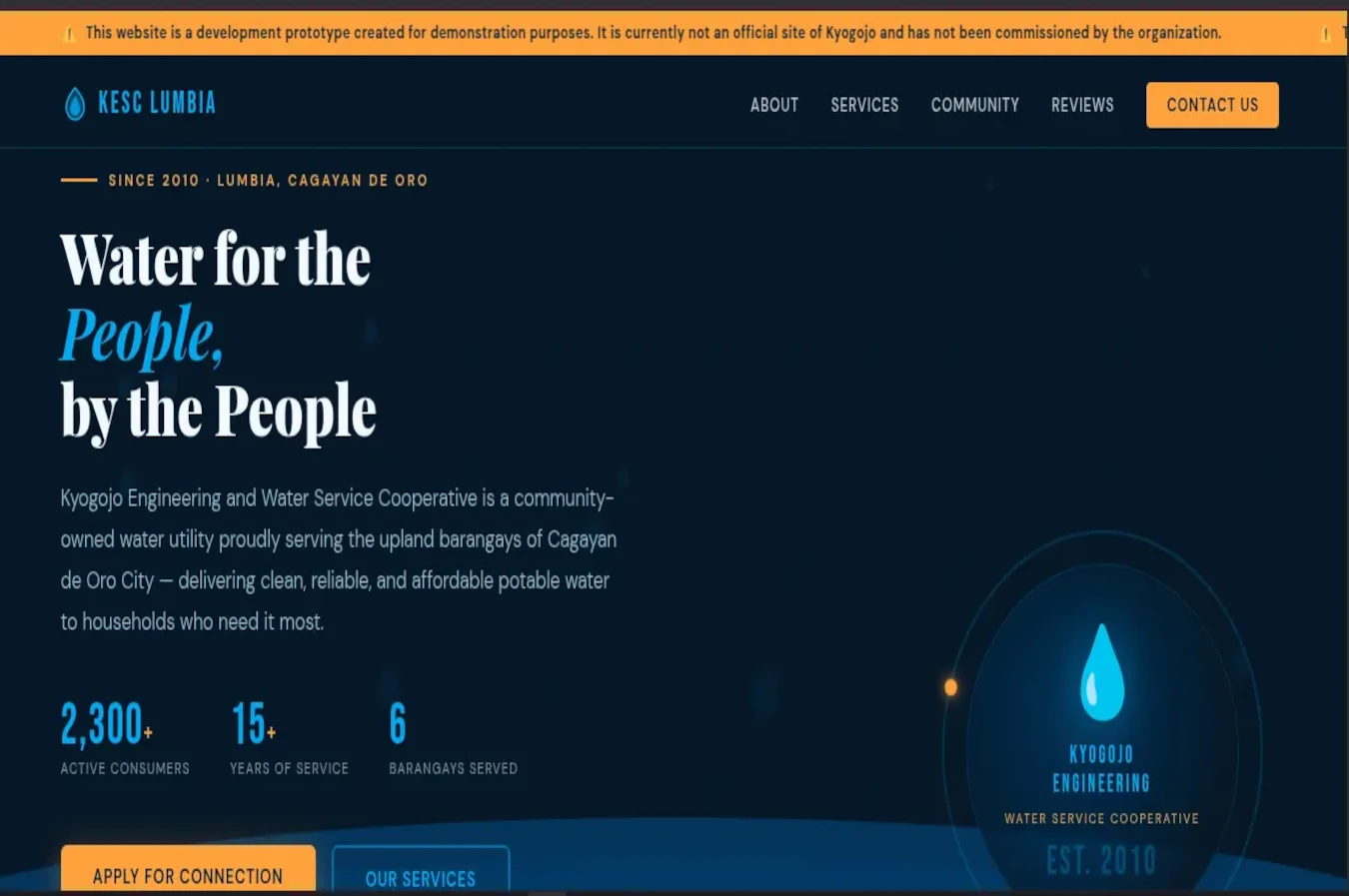
Project URL: kyogojo.pages.dev
Portfolio Exhibit: bongaceron.pages.dev
Role: Front-End Developer / Jamstack Specialist. I served as the UI/UX Designer and Frontend Developer for the Kyogojo Water Service Cooperative landing page prototype. Responsibilities included website planning, user experience design, visual design, responsive frontend implementation, content structuring, and performance-focused single-page landing page development.
1. Executive Summary
Kyogojo Engineering and Water Service Cooperative (KESC) is a community-owned utility serving over 2,300 households across the upland barangays of Cagayan de Oro City. Despite their vital role since 2010, the cooperative lacked a centralized digital touchpoint for consumers looking to apply for water connections or report service issues.
This case study details the development of a highly optimized, single-page proof-of-concept landing page. Built using a modern Jamstack stack and deployed on Cloudflare Pages, the project transitions a paper-heavy, fragmented community onboarding process into a lightweight, mobile-first digital channel.
2. The Problem & Local Context
Upland barangays in Cagayan de Oro (such as Lumbia, Baikingon, and Indahag) often deal with inconsistent mobile data coverage. For a public utility website to be useful here, it couldn't afford to be a heavy, database-driven site (like standard WordPress installs) that chokes on low-bandwidth mobile connections.
The cooperative needed a web presence that fulfilled three core requirements:
- Instantaneous Performance: Must load instantly on 3G mobile networks for rural and highland users.
- Structured Lead Capture: Replacing chaotic phone calls or physical visits with a clean, structured form for connection applications and leak reports.
- Clear Community Messaging: Highlighting their identity as a community-owned cooperative rather than a private corporation.
3. Technical Strategy & Architecture
To ensure maximum speed, security, and zero maintenance overhead, the site was developed using a decoupled, Jamstack architecture:
- Static Generation: The entire interface is pre-rendered into semantic HTML, optimized CSS, and minimal vanilla JavaScript. No heavy client-side frameworks were used, minimizing the bundle size.
- Global CDN Deployment: Hosted on Cloudflare Pages. By serving the entire site directly from the network edge, the Time-to-First-Byte (TTFB) is near-instantaneous, even from local mobile cells in CDO.
- Managed Edge Infrastructure & Hosting: By leveraging an advanced, serverless static architecture on enterprise-grade edge networks, the platform scales infinitely to handle traffic spikes. This setup eliminates the need for expensive dedicated servers or database patches. Instead, it transitions infrastructure management into a predictable, highly reliable hosted service that guarantees maximum uptime and continuous edge delivery.
4. Key Design & Implementation Features
A. Mobile-First Utility Dashboard Layout
Recognizing that the majority of local consumers access the internet via smartphones, the layout uses a clean, responsive grid. Essential information—such as covered barangays, office hours, and emergency phone numbers—is prioritized at the top of the visual hierarchy.
B. Segmented Inquiry Intake Form
Instead of a generic text box, the contact portal features a localized form designed around the cooperative's actual operational workflows. Users can explicitly select their specific upland barangay and choose from categorized inquiry types:
- New Water Connection Applications
- Service Interruption / Complaints
- Pipe Leak / Repair Requests
- Cooperative Membership Inquiries
This structure ensures that when connected to a serverless backend or email API, data maps directly to the right department.
C. Localized Social Proof & Trust Factors
To establish credibility for a legally recognized, NWRB-certified cooperative, the landing page integrates real-world community testimonials translated into the local vernacular (Cebuano/Bisaya), bridging the gap between digital utility and the community it serves.
5. Results & Technical Impact
- Ultralight Payload: By keeping dependencies to a minimum, the page size remains incredibly small, resulting in near perfect performance metrics and near-instant load times on mobile devices.
- Hardened Security: With no active database or backend server exposed to the public internet, the site is entirely immune to standard web vulnerabilities like SQL injection or dynamic server crashes.
- Frictionless UX: Consumers can instantly locate connection requirements and submit accurate location and utility data without stepping foot into a physical office.
6. Conclusion
The Kyogojo prototype proves that a public utility website doesn't need a bloated backend to be effective. By focusing on semantic markup, local user needs, and edge hosting via Cloudflare, the site demonstrates how a lean Jamstack workflow can solve real-world community accessibility challenges.
Visit the website I created here: kyogojo.pages.dev
Explore more lightweight, high-performance web solutions at bongaceron.pages.dev.